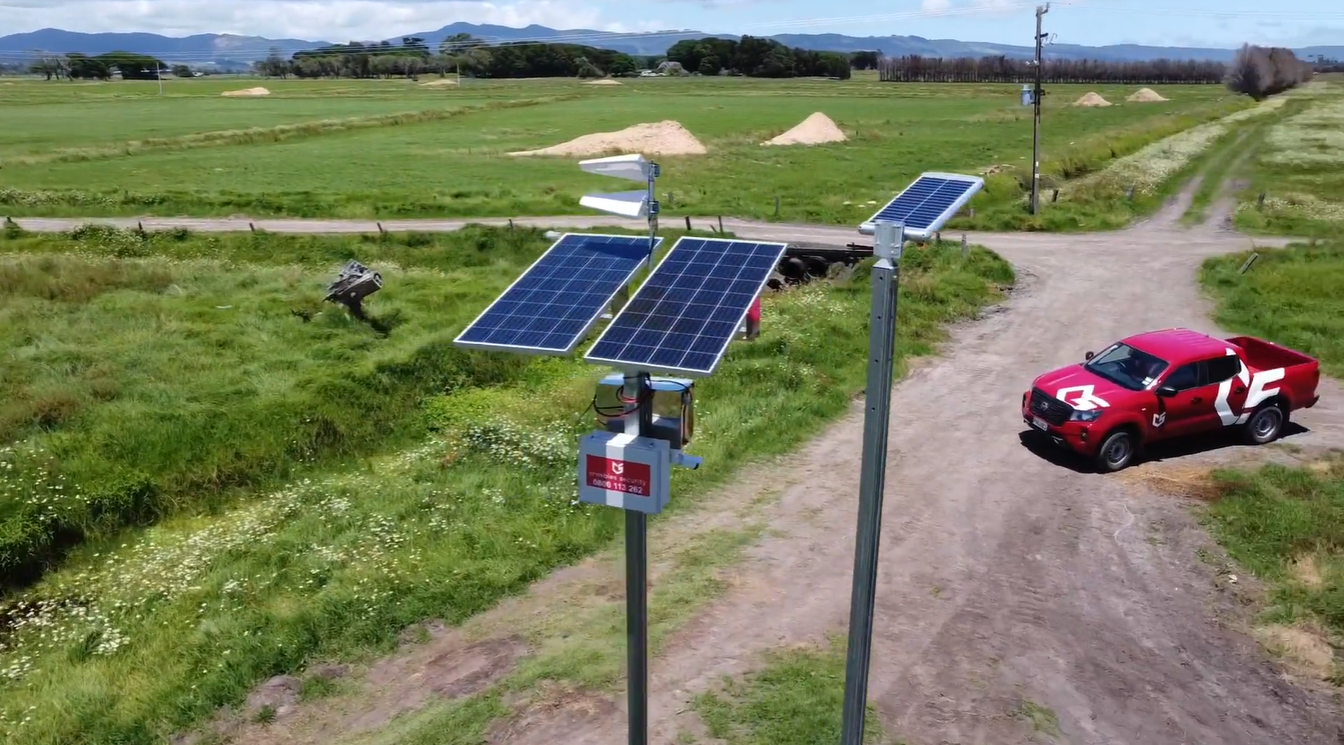
Security monitoring can be difficult when a facility is located far from reliable electricity or conventional network infrastructure.
Remote government facilities, construction sites, farms, warehouses, roads, schools, estates, telecommunications sites and other isolated locations may require surveillance even when connecting them to the national electricity grid is difficult or expensive.
Solar-powered CCTV provides one practical approach.
By combining solar panels, battery storage, CCTV cameras, communication equipment and video recording or remote monitoring, organizations can deploy surveillance systems in locations where conventional powered CCTV may be difficult to operate.
The technology does not eliminate every challenge associated with remote surveillance, but proper system design can make continuous or scheduled security monitoring more practical.
What Is Solar-Powered CCTV?
Solar-powered CCTV is a surveillance system that uses solar energy to power security cameras and associated equipment.
A typical system can contain:
Solar panels
Solar charge controller
Battery storage
CCTV cameras
Network equipment
NVR or other recording equipment
Wireless communication equipment
Mounting structures
Protective enclosures
Monitoring equipment
During daylight hours, the solar panels generate electricity. The charge controller manages the charging process, while batteries store energy for use when sunlight is unavailable.
Depending on the system design, footage can be stored locally or transmitted to an authorized monitoring location through available communication networks.
Why Remote Locations Present a Security Challenge
Remote facilities can face several challenges that make traditional surveillance difficult.
These may include:
Limited access to grid electricity
Unreliable power supply
Long distances between facilities
Limited physical security presence
Difficult maintenance access
Poor telecommunications infrastructure
Large areas requiring surveillance
High cost of installing conventional electrical infrastructure
For example, a construction site outside a major city may need surveillance throughout the night even though connecting the site to a stable electricity supply is impractical.
Solar-powered CCTV can provide an alternative power source for the surveillance equipment.
How Solar-Powered CCTV Works
A basic system follows this process:
Solar Energy → Charge Controller → Battery Storage → CCTV & Network Equipment → Recording/Remote Monitoring
During the day, solar panels generate electricity.
The charge controller regulates the energy going into the battery bank.
The batteries then provide power to the CCTV system when solar generation is unavailable, including at night.
Depending on the design, cameras can record footage locally or transmit it through a wireless or cellular connection to an authorized monitoring location.
The system must be properly sized so that the available solar generation and battery capacity are sufficient for the expected energy demand.
Key Benefits of Solar-Powered CCTV
1. Surveillance Without Dependence on Grid Electricity
One of the main advantages is the ability to deploy CCTV in areas where grid electricity is unavailable or unreliable.
Instead of waiting for conventional electrical infrastructure to reach a remote location, an appropriately designed solar system can provide an independent power source.
This can be useful for:
Remote government facilities
Construction sites
Farms
Warehouses
Roads
Estates
Schools
Industrial sites
Telecom locations
Rural infrastructure
2. Reduced Dependence on Generators
Generators can provide backup power, but they require fuel, servicing and regular operation.
For surveillance systems located far from urban centres, transporting fuel can add operational costs and logistical challenges.
Solar power can reduce the dependence on generator operation for CCTV equipment.
A properly sized battery system can keep cameras operating during periods when solar panels are not producing electricity.
3. Useful for Temporary Sites
Some security requirements are temporary.
Construction projects, road projects, event locations, temporary storage areas and other sites may require surveillance for a specific period.
Installing conventional electrical infrastructure for a temporary facility may not always be practical.
Solar-powered CCTV can provide a more flexible deployment option.
4. Remote Monitoring
A solar-powered CCTV system can be designed to transmit footage or alerts to an authorized monitoring location.
Depending on local connectivity, communication options may include:
4G/LTE
5G
Fixed wireless internet
Point-to-point wireless links
Fibre connectivity where available
Satellite connectivity for specialized deployments
The appropriate communication method depends on the location, coverage, bandwidth requirements and operating environment.
5. Protection of Critical Infrastructure
Remote infrastructure can be vulnerable because security personnel may not always be physically present.
Solar-powered surveillance can provide monitoring around locations such as:
Power infrastructure
Water facilities
Telecom installations
Roads
Bridges
Government assets
Agricultural facilities
Storage locations
Construction projects
The cameras can help security personnel monitor activity and review incidents.
6. Flexible Installation
Because the system does not necessarily require connection to the electricity grid, cameras can be deployed in locations where conventional electrical installation would be difficult.
This can make solar CCTV suitable for large outdoor areas and isolated sites.
However, installation still requires proper assessment of solar exposure, camera coverage, physical security and communications.
Important Components of a Solar CCTV System
Solar Panels
Solar panels provide the energy required to operate the system and recharge the batteries.
Panel capacity should be calculated according to the system's energy requirements and the expected solar conditions at the site.
Battery Storage
The battery stores energy generated during the day.
Battery capacity should account for:
CCTV power consumption
Network equipment
Recording equipment
Communication equipment
Expected nighttime operation
Weather conditions
Required backup period
Battery sizing is particularly important because cameras may need to operate continuously during periods without sufficient sunlight.
Charge Controller
The charge controller manages the energy flowing from the solar panels to the batteries.
Depending on the system design, technologies such as MPPT charge controllers may be considered to improve solar energy harvesting.
CCTV Cameras
Camera selection should depend on the surveillance objective.
Possible requirements include:
Day/night monitoring
Infrared illumination
Wide-angle coverage
Long-range viewing
PTZ capability
Weather resistance
High-resolution imaging
Motion detection
Low-light performance
The most expensive camera is not automatically the most suitable camera. The equipment should match the site and security requirements.
Communication Equipment
Remote monitoring requires a communication link.
Depending on the location, the system may use cellular, wireless, fibre or satellite connectivity.
Where cellular networks are available, a 4G or 5G router can provide connectivity for remote camera access.
Recording System
Footage can be stored locally or remotely.
Local storage can provide an important backup when communication connectivity is temporarily unavailable.
The storage design should consider camera resolution, number of cameras, recording mode and required retention period.
Site Assessment Is Critical
A solar-powered CCTV installation should begin with a site assessment.
The assessment should examine several factors.
Solar Conditions
The installation team needs to identify a suitable location for the solar panels and consider shading, orientation and expected solar availability.
Camera Coverage
The team should identify areas requiring surveillance and determine appropriate camera positions.
Communication Coverage
If remote monitoring is required, the available communication infrastructure should be assessed.
For cellular systems, signal strength and network availability should be checked at the actual installation location.
Security of Equipment
Solar panels, batteries and other equipment can themselves become targets for theft or vandalism.
The system should therefore include appropriate physical protection.
Environmental Conditions
The installation should account for:
Rain
Dust
Heat
Wind
Humidity
Flooding
Vegetation
Wildlife
Physical access
Outdoor equipment should be selected and installed according to the environmental conditions of the site.
Solar CCTV and Night-Time Security
A major consideration is how the system will operate after sunset.
Solar panels do not generate electricity at night, so the battery system must provide sufficient stored energy.
The design therefore needs to consider the complete daily energy cycle:
Daytime Solar Generation → Battery Charging → Night-Time Operation → Battery Reserve → Next Charging Cycle
Poor battery sizing can cause cameras to stop operating before sunrise.
For critical locations, additional energy and backup considerations may therefore be necessary.
Solar CCTV and Network Infrastructure
Solar-powered CCTV is not only a solar project.
It is also a networking and communications project.
A complete solution may require:
Solar Power + Battery + CCTV + Network + Communication + Recording + Monitoring
For multiple cameras, the system may require network switches, wireless links, fibre or other communication infrastructure.
This makes proper system architecture important before installation.
Using Solar CCTV Across Multiple Locations
Organizations with several remote facilities can establish centralized monitoring.
For example:
Remote Site A → Internet/Communication Network → Central Monitoring Centre
Remote Site B → Internet/Communication Network → Central Monitoring Centre
Remote Site C → Internet/Communication Network → Central Monitoring Centre
Authorized security personnel can then monitor multiple locations from a central facility, subject to appropriate network security and access controls.
This approach can be useful for organizations responsible for geographically distributed assets.
Security and Cybersecurity Considerations
Internet-connected CCTV systems need to be secured.
Organizations should consider:
Strong administrator credentials
Secure remote access
User authentication
Firmware updates
Network segmentation
Firewall controls
Restricted permissions
Secure communication
Access logging
Regular system maintenance
Remote access should be provided only to authorized users.
The CCTV system should also be considered part of the organization's wider ICT security environment.
Physical Security of Solar CCTV Equipment
Because solar CCTV installations may be located in isolated areas, the equipment itself needs protection.
Possible measures include:
Secure mounting structures
Anti-tamper hardware
Protective equipment enclosures
Appropriate camera mounting heights
Secure battery housing
Cable protection
Equipment alarms where appropriate
Strategic equipment placement
The security design should protect both the surveillance target and the surveillance equipment.
Maintenance of Solar-Powered CCTV
Remote installations require a clear maintenance plan.
Maintenance can include:
Solar System
Solar panel inspection
Cleaning
Battery inspection
Charge controller checks
Cable inspection
Electrical testing
CCTV System
Camera inspection
Lens cleaning
Camera alignment
Recording verification
Storage health checks
Firmware updates
Network System
Connectivity checks
Router inspection
Signal assessment
Network configuration
Remote access testing
Regular maintenance can help identify problems before they result in prolonged surveillance downtime.
Solar-Powered CCTV for Government and Institutional Facilities
Government institutions can use solar CCTV for facilities where conventional power infrastructure is unavailable or unreliable.
Potential applications include:
Remote government facilities
Roads and public infrastructure
Public schools
Healthcare facilities
Construction projects
Agricultural facilities
Water infrastructure
Warehouses
Government estates
Large public compounds
Border or perimeter facilities
Remote utility infrastructure
The actual application should be determined through a proper security and technical assessment.
When Solar CCTV May Not Be the Right Solution
Solar-powered CCTV is useful in many situations, but it is not automatically suitable for every location.
An assessment should determine whether:
Adequate sunlight is available
The required camera load can be supported
Communication connectivity is available
Battery capacity can meet the required operating period
Equipment can be physically secured
Maintenance access is practical
Local environmental conditions are suitable
For some facilities, grid electricity with UPS and other backup systems may be more appropriate.
The objective should be to select the infrastructure configuration that meets the actual operational requirements of the site.
How YasYum Ltd Can Help
YasYum Ltd provides integrated CCTV, electronic security, renewable energy and ICT infrastructure solutions.
Our solar-powered CCTV capability can combine:
Site assessment
CCTV system design
Solar power assessment
Solar panel installation
Battery storage
CCTV camera installation
Network infrastructure
4G/5G or other communication options where suitable
NVR/DVR deployment
Remote monitoring
Backup power
System testing
Training
Preventive maintenance
Our integrated approach allows the power, surveillance and communication components to be considered together rather than as separate installations.
For remote locations, this can help organizations develop a surveillance system that is designed around the site's security requirements, energy availability and communication infrastructure.
Conclusion
Security challenges do not disappear simply because a facility is located far from a major city or electricity infrastructure.
Remote sites can still contain valuable equipment, public assets, construction materials, infrastructure and sensitive facilities that require monitoring.
Solar-powered CCTV provides a practical option for locations where conventional power supply is unavailable, unreliable or expensive to extend.
However, successful deployment depends on more than installing cameras and solar panels. Proper site assessment, camera positioning, solar and battery sizing, communication planning, cybersecurity, physical equipment protection, storage and maintenance all need to be considered.
A properly designed system can bring together solar power, battery storage, CCTV, networking and remote monitoring to provide surveillance capabilities for remote and difficult-to-connect locations.
YasYum Ltd can help organizations assess remote facilities and design integrated solar-powered CCTV solutions based on their security, energy and communication requirements.
Need solar-powered CCTV for a remote facility?
Contact YasYum Ltd to discuss the site and arrange a technical assessment.
YASYUM LTD
Integrated Technology, Security & Renewable Energy Solutions
Suite 38, Dumec Plaza, Area 1, Section 1, Abuja, FCT, Nigeria
Phone: 08036202908, 08028720549
Email: info@yasyum.com
Website: yasyum.com
Tags


Discussion
Comments
No comments yet.
Be the first to share your thoughts on this article.
Leave a comment
Join the discussion
Your email won't be published. Comments are reviewed before appearing.